
The Lao Tzu Detox
empty first

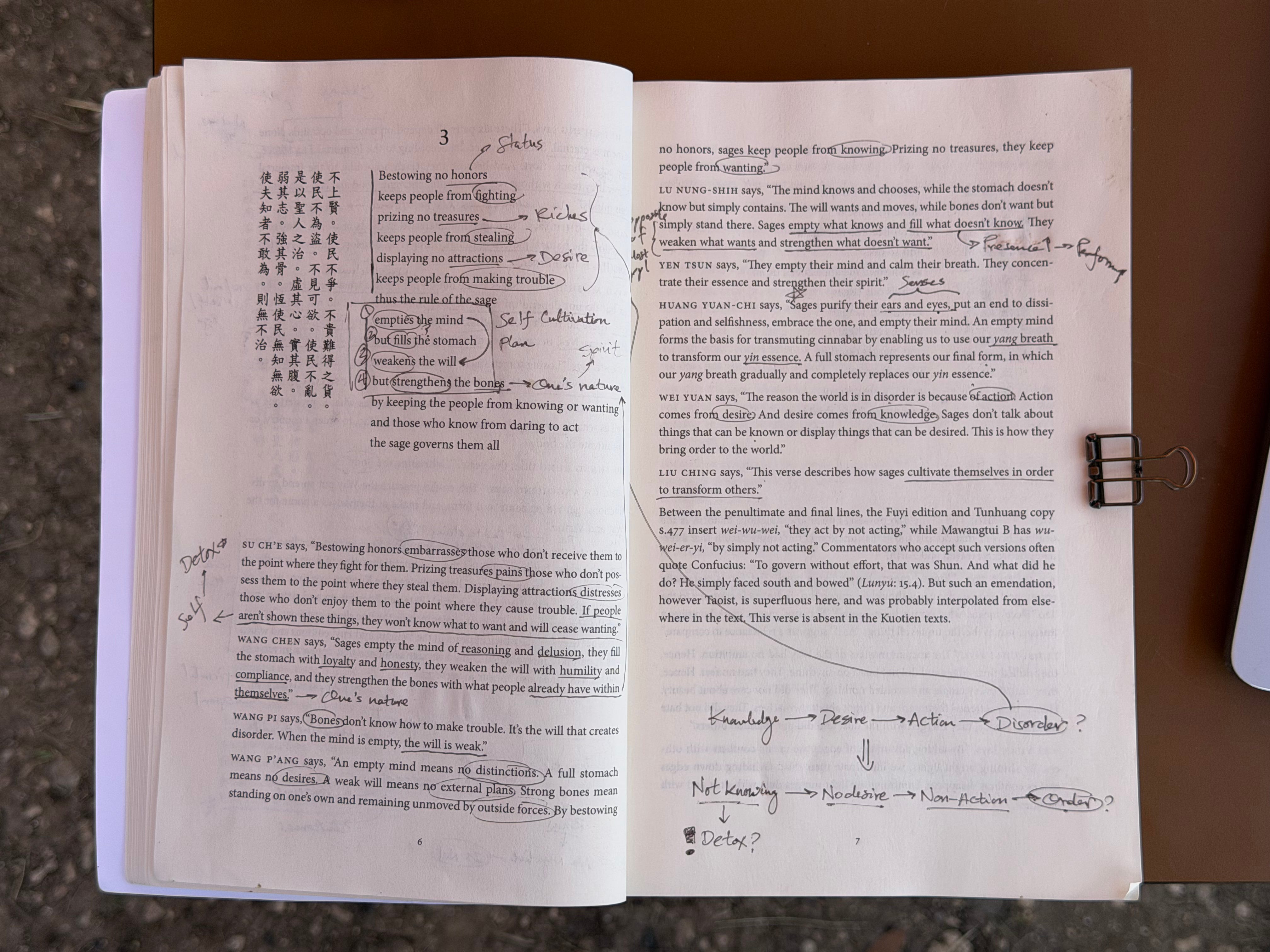
For most of my career, my single greatest strength was strategy. I could see ten moves ahead. I prepared for things obsessively. I’d spend two days preparing for a one-hour mission critical meeting.
I thought this was rigor. What it actually was, I now realize, was anxiety dressed up as preparation. The dark side of strategy is overthinking. The dark side of overthinking is anxiety — projecting the future into the present, so that you’re never actually in either one.
I bring this up because I want to be honest about who is writing this essay. As I made this week’s Taoteching Verse #3 deep dive video, I realized the person most in need of it is not the one who hasn’t read enough self-help books. It’s the person who has read all of them, who has built systems, frameworks, second brains. Who knows their MBTI, Big Five, Clifton’s Strengths, and attachment style. Who has a Notion template for everything. It’s the person who, on hearing empty the mind, instinctively reaches for a meditation app to schedule it.
That is, more or less, where I started.
Verse #3 gives a four-line prescription:
Thus the rule of the sage
empties the mind
but fills the stomach,
weakens the will
but strengthens the bones
In the Verse #3 video, I worked through this line by line. I synthesized it into a table:
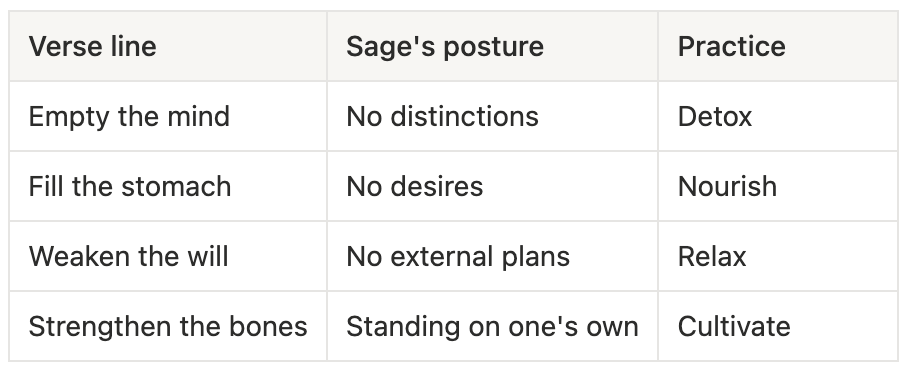
Empties the mind
When most of us hear empty the mind, we hear quiet the mind. Less noise, fewer notifications, a meditation cushion. These things are not bad — I do them, they help — but they are not what the verse is asking.
The mind Lao Tzu wants us to empty is not the mind that’s loud. It’s the mind that’s reasoning. The mind that strategizes, plans, anticipates, optimizes. Wang Chen, one of the commentators, says it directly: sages empty the mind of reasoning and delusion. He puts the two words together because they’re the same thing. The reasoning mind, pushed far enough, becomes the deluded mind. We rationalize because we reason. We strategize because we reason. We project ourselves into the future and then live there instead of here.
Wei Yuan, another commentator, traces the chain: knowledge produces desire, desire produces action, action produces disorder. Once you see this chain, you see it everywhere. The version of me that prepared two days for a one-hour meeting was producing knowledge (about the meeting), which produced desire (for a particular outcome), which produced action (a thousand contingency plans), which produced disorder (anxiety and brittleness when things didn’t go according to plan).
The reasoning mind, when it has been your strength for a long time, doesn’t stop because you ask it to.
This is what makes emptying the mind hard. The reasoning mind is, for many of us, the part we’ve been most rewarded for. It’s how we got into the school. It’s what got us promoted. It’s the engine our identity is built around. To empty it feels like losing the most valuable part of ourselves.
But the proof is in the results. The best videos I’ve ever made on this channel were the ones where I didn’t know what I was doing. My most viewed video, by a wide margin, is one I made during the pandemic about mind mapping and project management — and at the time I had no idea how to edit videos, no YouTuber playbook, nothing. I just wanted to help people during chaos. A friend of mine, a weight loss coach who makes serious money on Instagram, told me the same thing. His first videos, when he didn’t know any of the best practices yet, were the ones that took off with millions of views.
This is the contrarian nature of the Tao. The reasoning mind says: learn the playbook, then execute. The Tao says: the playbook is the problem. Or more precisely, the playbook is what closes you off from your own nature, your authenticity, which is the actual source of anything good you’ve ever made.
To empty the mind, in this verse, is to release the strategizing function long enough for something else to come forward. Your nature. The thing underneath the optimizing.
Fills the stomach
Once the reasoning mind quiets, something is left. Lao Tzu calls it the stomach.
Commentator Lu Nung-Shih says it cleanly: the mind knows and chooses while the stomach doesn’t know, but simply contains. The stomach receives. The stomach feels. The stomach doesn’t reason about whether it should be receiving or feeling.
To me this means filling yourself with what actually nourishes — physical food, yes, but also the people, environments, and activities that make you feel full and content rather than stimulated. The opposite of what most of us are doing most of the time.
Weakens the will
The will is the part of us that pushes. Plans, drives, executes, persists.
We’re taught from childhood that the will is what makes us effective. Lao Tzu disagrees, and what he says is one of the strangest claims in the book: weaken it.
Not strengthen it. Not refine it. Weaken it.
The image I keep coming back to is a spring. A spring has no will. A spring just flows. The water that comes out of it is enormous in its effects — it carves valleys, feeds rivers, gives life — but the spring itself is not pushing. It’s releasing. The action comes from what’s already there, not from what’s being added on top.
The Taoist sage moves like this. There’s still action. Sometimes a great deal of it. But there’s no will behind the action. The action arises from nature, the way water arises from a spring.
To weaken the will, in practice, is to relax your grip on what you think you’re supposed to be doing, and let the work come from the deeper place where it was always going to come from anyway.
Strengthens the bones
The bones are what’s left when everything else has been emptied or weakened.
Wang Pi, the third-century commentator, has my favorite line in this verse’s commentary tradition: bones don’t know how to make trouble. The bones don’t strategize. The bones don’t desire. The bones simply hold the body up. They were there before you started thinking. They’ll be there after you stop.
To strengthen the bones is to come back to your own nature. Not the version of you that performs well in meetings. The version that exists when no one is looking and there’s nothing to optimize.
I think of a tree in winter. It sheds the leaves that everyone admired and stops trying to expand outward. The trunk thickens. The roots go deeper underground, where no one can see them. This is the part of the tree’s life that no one photographs, and it’s also the part that holds everything else up.
Most of the most important work of a life happens here, and most people will never see it. That’s the point.
Empty first
The four “steps” are really one step.
Empty the reasoning mind, and the stomach fills on its own with the older knowing. Fill the stomach, and the will has nothing left to push against, and weakens. Weaken the will, and your nature — what was always there underneath — strengthens by being uncovered.
Most prescriptions for living go in the other direction. Start with strengthening: build discipline, build willpower, build a productivity system. Construct the inner life from the outside in. Lao Tzu’s move is the opposite. Start at the source. Empty first. The rest follows.
A week of this isn’t enough to undo a lifetime of being rewarded for thinking. But a week is enough to feel the shape of it. To get the first taste of what’s on the other side of strategizing. To remember that you have a stomach, a body, a nature — and that they were here the whole time, waiting for the mind to get tired enough to stop.
That’s the practice for this week.
Empty first, my friends.
If you haven’t seen this week’s Verse #3 deep dive yet, here it is: