
“Post-Productivity” Productivity
sprinting with AI & the Tao

On Friday we held the kickoff call for the 2-Week Expansion Community Sprint, and I’ll be honest, it was a bit of a leap of faith.
The Sprint is something I built years ago, back when I was moonlighting as a productivity YouTuber, and the framework went on to launch just about every major project I’ve shipped in the last five years.
But my whole relationship to productivity has dramatically shifted since our last sprint in 2024 — I’ve moved away from pure outcomes and toward flow and presence — so I really wasn’t sure how the call would go.
The alignment challenge I had to work through, out loud and in front of everyone, came at two levels:
The philosophical one: can you sprint and set goals and still be effortless i.e. practice wu wei? Can you chase outcomes while surrendering to them? How does this reconcile with Verse #24 which explicitly says: those who stride (i.e. sprint), don’t walk. It’s another way of saying, hey man, sprinting’s going to burn you out.
The practical one: AI has advanced so far, so fast without any signs of slowing. The old shape of a “sprint” barely holds anymore when you can press a button and something that used to take 3 days of work now gets done in 30 seconds. It fundamentally changes what “productivity” even means these days.*
Reconciling those two is what I’ve been clumsily calling “post-productive” productivity — and yes, I know I need a better word for it. This whole sprint is an experiment in it.
What follows are the takeaways from the workshop. If the usual productivity systems have ever left you more stressed than supported, I think there’s something here for you.
*Especially when the goal of AI companies is to build what OpenAI charter calls “highly autonomous systems that outperform humans at most economically valuable work.”
The keywords are “economically valuable work”, aka what we currently call “productivity”. This is also what we often tie our identities and self-worth around.
This begs the question: what is actually valuable in the post-productivity world?
If you get nothing else from this workshop, then let this question sit with you throughout the Sprint. Because your answer, or at least pieces of that puzzle, will become increasingly important, and indeed valuable, as time goes on.
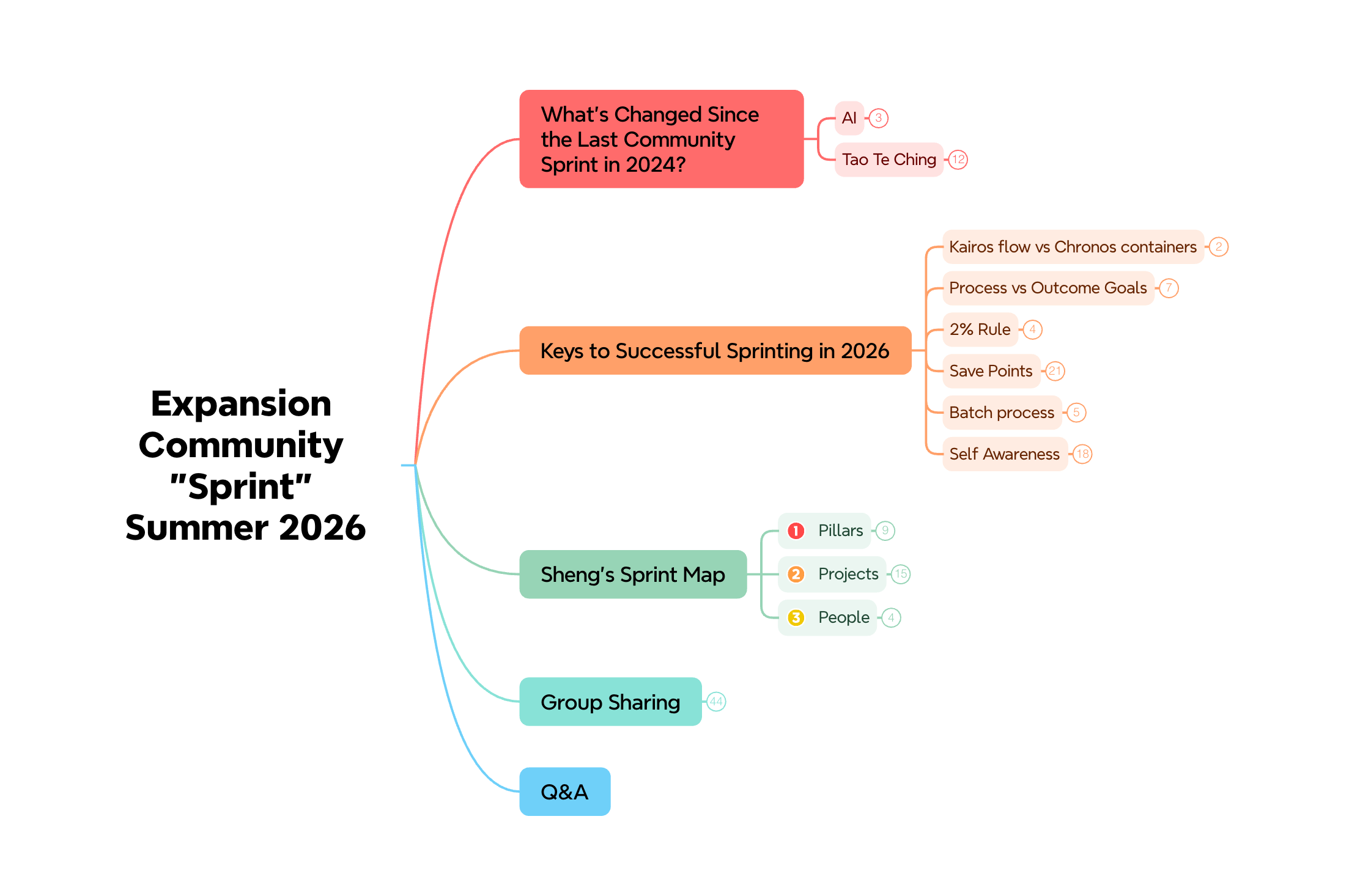
Sprinting in the right direction
The first thing I wanted to reframe is the direction we sprint in. There’s no point sprinting hard in the wrong direction. That’s just building in the wrong direction faster.
In the Tao Te Ching there’s the idea of wu wei, effortless action, where the sage produces ten thousand things and yet experiences all of it as play. The way I take it is that effortlessness comes from being true to your nature.
A dog can’t help but be a dog, a cat can’t help but be a cat, a sage can’t help but help people. The rest of the world sees them as productive, when really they’re only being themselves.
So before any of us set a single goal, I wanted us to ask what we’re actually aligned to. Over the years I’ve leaned on a few lenses for this — CliftonStrengths, VIA values, Gene Keys — never as gospel, only as starting points and sanity checks.
There’s an old line from Deng Xiaoping, the man who opened up China’s economy after the delusional Mao era:
I don’t care if the cat is black or white as long as it catches mice.
I could care less where an insight comes from. If something resonates at a deep level, I’ll experiment with it, live into it to see if it holds water.
You can’t think your way into your true nature, much less alignment. It reveals itself when you go out into the world, live something, and notice whether it actually resonates.
Where are you pointing the lever?
The other half of the challenge is the practical one, and it’s the elephant in the room: AI. When I ran my last sprint in 2024, the question was still whether AI could help with this or that task. That question has more or less dissolved.
The reflex now is closer to “just automate everything,” because AI will help you design, build, and automate at a scale that didn’t exist a couple of years ago. It’s an enormous lever. But a lever needs a fulcrum, and we’re the fulcrum, so the real question becomes where we point all that leverage.
For me, that means automating the parts of my work that were never my actual value-add. I’ve been looking at handing off pieces of my YouTube editing and publishing — thumbnails, titles, descriptions — because my value to you lives in sitting with the Tao Te Ching, or sitting with a mind map, and not in the publishing mechanics. If I can let those parts go* and become more present as a result, that’s the whole objective.
There’s a trap in this, though, and it’s worth naming. You can spend your entire life automating your life and never get around to living it. There are productivity folks who run their whole existence on Notion, and at some point you have to wonder whether they’re actually living.
So I gave myself a rough ceiling, maybe four hours, for the YouTube automation, and at the end of that I get to ask whether it’s worth going further or whether I’d rather just do the fifteen-minute task by hand and get on with my life.
One of our workshop participants made a sharp point on the call too: every automation you build carries a maintenance cost. Something shifts underneath it, it breaks, and you’re right back where you started. The practical question, then, goes past what I can automate, toward what’s actually worth automating, and what I’d rather keep doing as a human.
*Funny enough letting go of micro-management was the big epiphany during a wilderness solo this year, where the TTC Verse #48 blew me wide open to how tight I had been.
Process over outcome, and a lot of self-grace
The biggest shift in how I run a sprint now lives in the difference between process and outcome. An outcome goal is something like hitting ten thousand views, or waking up every morning feeling fresh. A process goal is filming a Tao Te Ching video every week, or getting into bed by 10pm. The difference matters because outcomes were never fully in our control. Even if I get into bed by 10, I can’t guarantee I’ll fall asleep, and I can’t guarantee I won’t wake up at 3 or 4am, which happened to me twice last week. What I can control is the process.
Once you see that, a lot of self-loathing starts to look pointless. How many times have we beaten ourselves up over an outcome we were never holding the strings on? That kind of self-judgment robs us of presence, which lowers our performance anyway. So one of the things I’m practicing this sprint, and inviting everyone into, is self-grace around the outcomes we don’t control, and real attention on the process — including the question of whether it’s the right process. The right process, by my current and still-evolving definition, is one that raises the probability of a good outcome and that I really enjoy, because it’s aligned to my nature. I still use the old SMART criteria — specific, measurable, actionable, realistic, time-framed — but I point them at the process rather than the outcome.
The 2% Rule
Most of us know the Pareto Principle, or commonly known as the 80/20 rule, where 20% of what we do drives 80% of the results. On the call I floated something more extreme that I’ve been calling the 2% Rule.
Thirty minutes is ~1.8% of the 1,440 minutes in a day, which rounds up to 2%.
So the question becomes:
What’s the 2% of what I do that’s responsible for 98% of downstream impact?
In operations there’s the concept of a bottleneck, the one constraint that slows the whole system down. You smooth it out, and then you go looking for the next one. One by one, each smoothed bottleneck eventually makes a much more streamlined system.
For me, right now, that bottleneck is sleep.
My single non-negotiable for the next two weeks is getting into bed by 10pm, no exceptions, for fourteen days straight. If I accomplish nothing else this sprint but I nail that 2% (which is the 30 minutes it takes me to shower and “sprint” into bed ;), I’ve won, my friends.
I actually got a head start. I was at a dinner party the other night, and when it hit 9pm I stood up like Cinderella and said my goodbyes — and funnily enough, three other people decided they should head out too. Apparently my taking a stand, literally, gave others permission to do the same.
I got home at 9:30pm, got ready, and out of curiosity looked at the clock before hitting the sack.
It read 9:58.
Talk about gamifying life.
Save points and switching costs
A couple of practical pieces for anyone using the sprint to move a project forward.
The first is what I call save points, borrowed from role-playing games, where the designers place checkpoints so you never have to start the hundred-hour game from scratch.
The example I gave on the call was the a little stock-picking app I was building for my dad last week.
I broke the work into checkpoints — learn to vibe code, set up the tools, build the mockups, and so on — so that when I stepped away and came back, I resumed from a saved point rather than from zero. Starting over and over again is its own kind of demoralizing, and save points are how you sidestep it.
The second is batch processing, which is really about respecting switching costs.
Getting into a designer’s headspace is different from getting into a social headspace, and every time your day jumps between the two you pay a hidden tax, both in focus and in the felt experience of the day.
So wherever I can control my time, I block it: half a day for one mode, half a day for another, and I try to simply be that one thing for that stretch.
Use Chronos containers to get into Kairos flow
This is where the two clocks come in, which longtime readers know I keep returning to.
A sprint is a Chronos container — tracked, measured, two weeks with a clear start and end. I build that container because bounded, tracked time is, paradoxically, what lets me drop into Kairos: the timeless, flow kind of time where the work becomes play.
The structure is what makes the flow possible. And it’s also the structure I lean on to keep the AI leverage in check — a four-hour container around automation is a Chronos boundary in service of staying present.
The real prize is self-awareness
For all the talk of goals, the most important thing a sprint leaves you with is self-awareness.
The goals and the assessments are only ever starting points. It’s by going out and living them that you learn what truly resonates and what doesn’t. That’s why the reflection is built into the structure — a midpoint check-in halfway through, and a fuller retrospective at the end.
I reflect along two tracks. The first is the familiar corporate one: what went well, what didn’t, what I’d improve. The second is quieter and more about feeling: what gave me energy, what drained it, what I want to continue, and what I want to let go of.
Whatever you accomplish or don’t, the self-awareness is the one thing you actually carry with you, between sprints and between seasons of life. It’s also a way of training the heart — of getting better at asking how something really felt.
What this workshop taught me
I won’t share everyone’s individual goals here; that part belongs to our participants who joined our call. But I’ll say the room surprised me.
I went in bracing for a productivity call, and what emerged was something gentler. Several people set their goals around creating space, around presence, around healing, around taking small steps without forcing a timeline onto them.
More than one person framed their version of the 2% as something quite gentle, sometimes smaller than they could reach on a hard day, and gave themselves permission to let it be exactly that.
It seems this “post-productive” thing resonates more widely than I expected, especially with people who’ve found that mainstream productivity systems don’t fit.
Join the Sprint
Consider this your call to join our “Sprint” — you don’t need to be a paid member to join.
The Sprint begins Monday, June 8. Head over to the original post, Who’s Itching for a Sprint, and drop your focus areas and process goals in the comments.
I’ll post my midpoint reflections on Sunday the 14th and my retrospective on Monday the 22nd. You’re welcome to share yours in the comments each time.
Keep it simple — pick a small handful of focus areas, find your non-negotiable 2%, and let the rest follow the process.
Less talking, more doing.
Most importantly, more being.
I’ll see you on the road, my friend.
- S

Simply an amazing piece and excited to join the sprint! I LOVE this post-productivity idea since this is truly what I've been struggling with lately - the discipline to start a business and to start a business with intention and flow (not grit & grind).